Are you planning to invest in a palm shell charcoal production business? Many investors focus only on the price of the carbonization machine, but the real project budget involves much more than equipment alone. Land preparation, labor costs, electricity consumption, raw material transportation, and environmental protection systems all influence the total investment. Understanding these costs can help you avoid unexpected expenses and improve project profitability.
Why Palm Shell Charcoal Projects Continue to Grow
Palm shell charcoal has become a popular biomass fuel in many countries because it offers high calorific value, low ash content, and stable combustion performance. Palm oil processing plants generate large quantities of palm kernel shells every year, which creates abundant raw materials for charcoal production. Many factories, barbecue charcoal suppliers, and activated carbon manufacturers now purchase palm shell charcoal as an eco-friendly fuel source.
As demand increases, more investors start building palm shell charcoal plants near palm oil processing areas. However, before starting the project, investors need to evaluate the complete cost structure carefully.
Land Cost and Factory Construction
Land investment usually depends on plant capacity and local industrial land prices. A small palm shell charcoal plant may require only 1,000–2,000 square meters, while a large-scale production line may need over 5,000 square meters for raw material storage, carbonization workshops, cooling areas, and finished product warehouses.
Factory construction costs include:
- Workshop buildings
- Concrete foundations
- Raw material storage sheds
- Drainage systems
- Dust collection areas
- Environmental protection facilities
If local regulations require emission treatment systems, investors may also need to install smoke purification equipment and wastewater treatment systems.
Labor Cost for Daily Operation
Labor expenses vary greatly between countries and production scales. A semi-automatic palm shell charcoal plant generally requires workers for:
- Raw material feeding
- Equipment operation
- Material transportation
- Packaging
- Quality inspection
- Equipment maintenance
A fully automatic production line can reduce labor demand significantly, but it usually increases initial equipment investment. Many investors choose automatic feeding and discharging systems to improve efficiency and reduce long-term labor costs.
Power Consumption and Energy Expenses
Electricity consumption directly affects operating costs. Main power-consuming equipment usually includes:
- Palm shell crusher
- Carbonization furnace
- Conveyor systems
- Cooling systems
- Dust collectors
- Packaging machines
Some advanced continuous carbonization systems can recycle combustible gas generated during carbonization and use it as heating fuel. This design helps reduce fuel consumption and improves energy efficiency.
Equipment Investment Breakdown
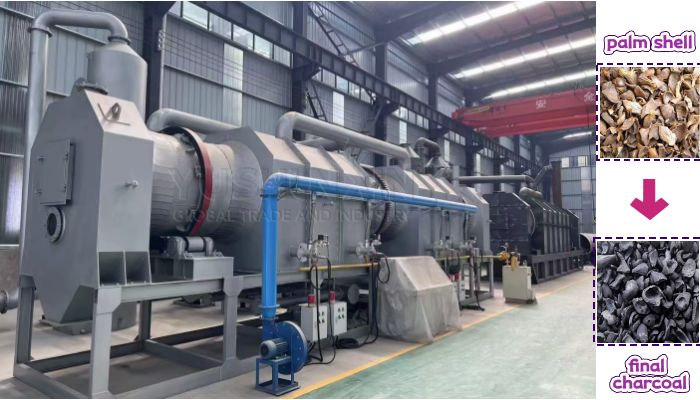
The equipment budget often represents the largest part of the project investment. A complete palm shell charcoal production line may include:
loader feeder → crusher → rotary screening machine → continuous carbonization furnace → cooling machine → charcoal crusher → charcoal briquette machine → drying system → packaging machine
Different capacities, automation levels, and environmental protection standards can greatly affect equipment prices. Investors should select suitable configurations based on raw material supply, target production output, and local environmental regulations.
Transportation and Raw Material Costs
Transportation costs often become a hidden expense in charcoal projects. Palm shells contain bulk volume, so long-distance transportation can increase production costs rapidly. Many successful plants choose locations close to palm oil mills to reduce logistics expenses.
Raw material moisture also affects operating costs. Wet palm shells may require additional drying before carbonization, which increases fuel and electricity consumption.
How to Reduce Overall Investment Risk
Investors can lower risks by selecting suitable plant capacity, reliable equipment suppliers, and energy-saving carbonization technology. Careful planning of land layout, raw material sourcing, and automation systems can improve long-term profitability and shorten return-on-investment periods.
If you want to build a profitable palm shell charcoal plant, you should evaluate every cost factor carefully before purchasing equipment. A professional production line design can help you reduce operating expenses, improve charcoal quality, and maximize project efficiency. Visiting: https://www.ysxcharpro.com/product/palm-charcoal-production-line/
Leave a Reply