Regional conditions decide whether a biomass project earns a stable return, and you, as a recycling company or as an industrial project investor, compare feedstock markets before you commit capital to a thermal line. The continuous carbonization production line cost structure reacts to labor rates, electricity tariffs, transport distance and local demand for charcoal or biochar. The continuous carbonization production line market outlook therefore differs between Africa, Southeast Asia and Europe, and your feasibility study needs regional data rather than a generic price list.
Which regional factors change the cost of a continuous carbonization production line?
Labor rates and electricity tariffs change the operating section of the budget, and those two items influence whether your project runs one shift or three shifts. Port charges and inland freight change the capital section, because a large reactor, a dryer and a briquetting section travel as heavy cargo. Local demand for charcoal, biochar and wood vinegar changes the revenue line, and that demand determines the product mix your production line targets. Your analyst compares these four groups for each candidate region and ranks the locations that keep the payback period inside the investment window.
How do feedstock prices and biomass availability shape carbonization line economics?
Feedstock availability within a fifty kilometer radius protects your margin, because transport of low density biomass erodes profit faster than any other cost. Rice husk, palm kernel shell, coconut shell, sawdust, straw, bamboo and agricultural residue behave differently inside a carbonization furnace, and each material changes the residence time your operators use, so a palm shell carbonization production line shows how one feedstock route configures the dryer, the reactor and the briquetting section. A region with year-round harvesting keeps the processing equipment busy, while a region with one harvest season needs storage planning. Your procurement team secures supply contracts before the equipment order, and that sequence gives lenders confidence in the revenue forecast.
Which carbonization equipment items adapt to different regional conditions?
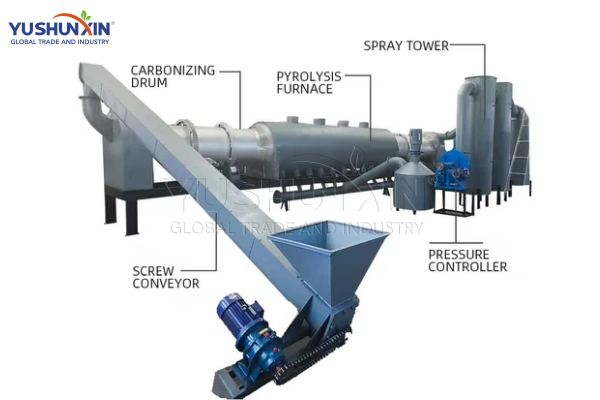
Continuous carbonization machinery with adjustable screw speed handles several biomass types, and that flexibility reduces the risk that your plant depends on one supplier of raw material. A rotary drum dryer removes moisture that varies with the rainy season, and a gas cleaning section keeps emissions inside local limits. The syngas return line feeds heat back to the reactor, and that internal energy loop lowers the fuel cost that your plant pays per tonne. Modular carbonization equipment allows a first phase of two tonnes per hour and a later expansion without replacing the main furnace.
How do you build a cost model for a continuous carbonization production line?
A reliable model separates capital expenditure, working capital and operating expenditure, and that separation shows which assumption drives the result. A biomass carbonization line investment planning sheet covers site preparation, utilities, laboratory equipment and operator training, because these items appear in every project. A turnkey carbonization production line budgeting approach also includes carbon credit revenue where the host country recognizes biochar as a removal pathway. Your finance team tests the model against three feedstock prices, and the sensitivity table becomes the core of the investment memo.
Conclusion for project investors and recycling companies
Regional market analysis turns a technical proposal into a bankable project, because lenders fund assumptions that your team supports with local data. A carbonization technology provider that documents energy balance, mass balance and emission control helps your engineers validate those assumptions. The charcoal market rewards producers who keep moisture, ash and fixed carbon inside the specification that buyers require. If your team needs the next level of detail for a specific region, you can learn more about https://www.ysxcharpro.com/whats-the-price-for-a-continuous-carbonization-furnace/ before the next review with your investment committee.