Recycling companies already move large volumes of organic material through their yards, and that material often leaves the site with little or no processing. A biomass carbonization plant design adds a conversion step that turns residue into charcoal, biochar and recoverable heat. You, as a recycling company owner or as a project investor, evaluate that design against three questions: feedstock security, product quality and operating cost. A profitable biomass carbonization plant answers those three questions with documented data instead of general promises, and that documentation supports both the bank file and the sales contract.
Which design decisions make a biomass carbonization plant profitable?
Capacity selection ranks first, because a plant that matches the available feedstock avoids both idle hours and material shortages. The second decision covers the drying configuration, and that configuration defines the moisture range that the plant accepts. The third decision fixes the product mix between lump charcoal, briquette charcoal and agricultural biochar. Your engineering team models each mix against the local price list, and that model shows which combination delivers the highest margin for the same equipment investment.
Which carbonization equipment raises the output value?
A continuous carbonization furnace with a controlled temperature profile produces uniform char, and uniformity supports a premium price in the charcoal market. A screening section separates fines from lumps, and that separation allows your company to serve two buyer groups at once. A briquette press converts fines into a uniform product with higher density. The carbonization furnace technical principle that governs residence time and gas flow also determines how much of the feedstock leaves as saleable carbon.
How does feedstock diversity protect the revenue of the plant?
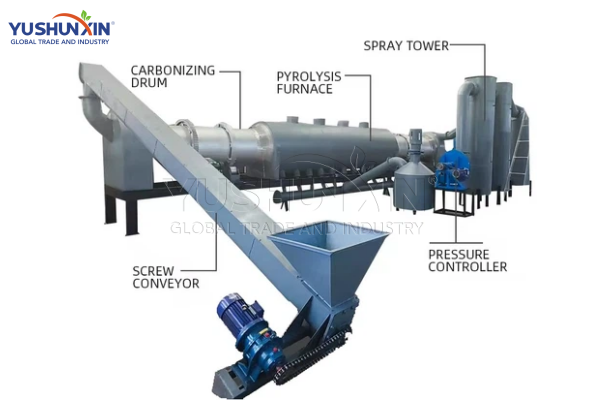
A plant that accepts palm kernel shell, coconut shell, rice husk, sawdust, bamboo and fruit residue keeps running when one supply source pauses. A palm charcoal production line for recycling companies demonstrates how the dryer, the reactor and the cooling section adapt to one dense feedstock, and the same design accepts other materials with an adjusted feed rate. Storage capacity for two weeks of material protects the operating schedule during the rainy season. Your procurement team also signs one backup contract for every primary supplier, because that redundancy keeps the plant at full output throughout the year.
How do recycling companies sell biochar and charcoal into regional markets?
Regional buyers include household fuel distributors, barbecue charcoal packers, water treatment suppliers and agricultural cooperatives that use biochar as a soil amendment. Your commercial team prepares a specification sheet for each buyer group, because ash content, moisture and particle size differ between applications. A profitable biomass carbonization plant also registers carbon removal units where the national framework recognizes biochar, and that registration adds a second revenue line. The sales plan then matches production volume with contracted offtake, and that match protects the cash conversion cycle of your business.
Conclusion for recycling companies and project investors
A carbonization plant earns its return when feedstock, equipment and offtake contracts operate as one system. A continuous carbonization system supplier that documents energy balance, output quality and maintenance intervals gives your management team the figures it needs for the investment decision. The biomass product also stores carbon in a stable form, and that stability supports environmental claims that your clients value. If your team needs a plant design reference for the next phase, you can learn more about https://www.ysxcharpro.com/product/palm-charcoal-production-line/ before the next planning meeting.